IGF History
The Institute of Geophysics has a rich and long-standing history of geophysical research development in Poland. Since its establishment in the aftermath of World War II, the Institute has played a significant role in rebuilding the national scientific community in geophysics and in advancing research on atmospheric physics, Earth-system processes, and modern methods of environmental observation. In the following decades, the Institute’s scientific activities gradually expanded to include the development of optical and photonic technologies, which today constitute an important component of its research. The history of the Institute of Geophysics is a story of how a modern, interdisciplinary research center arose from post-war reconstruction. The brief description below is only an introduction to this history. The publication “Od jądra Ziemi do gwiazd. Krótka historia Instytutu Geofizyki FUW” provides a detailed account of both the beginnings of geophysics at the University of Warsaw and the Institute’s subsequent development. We encourage readers to consult the full publication to learn about the development of geophysical research in Warsaw, the Institute’s most important scientific achievements, and the role of its staff in shaping modern geophysics in Poland and the world.
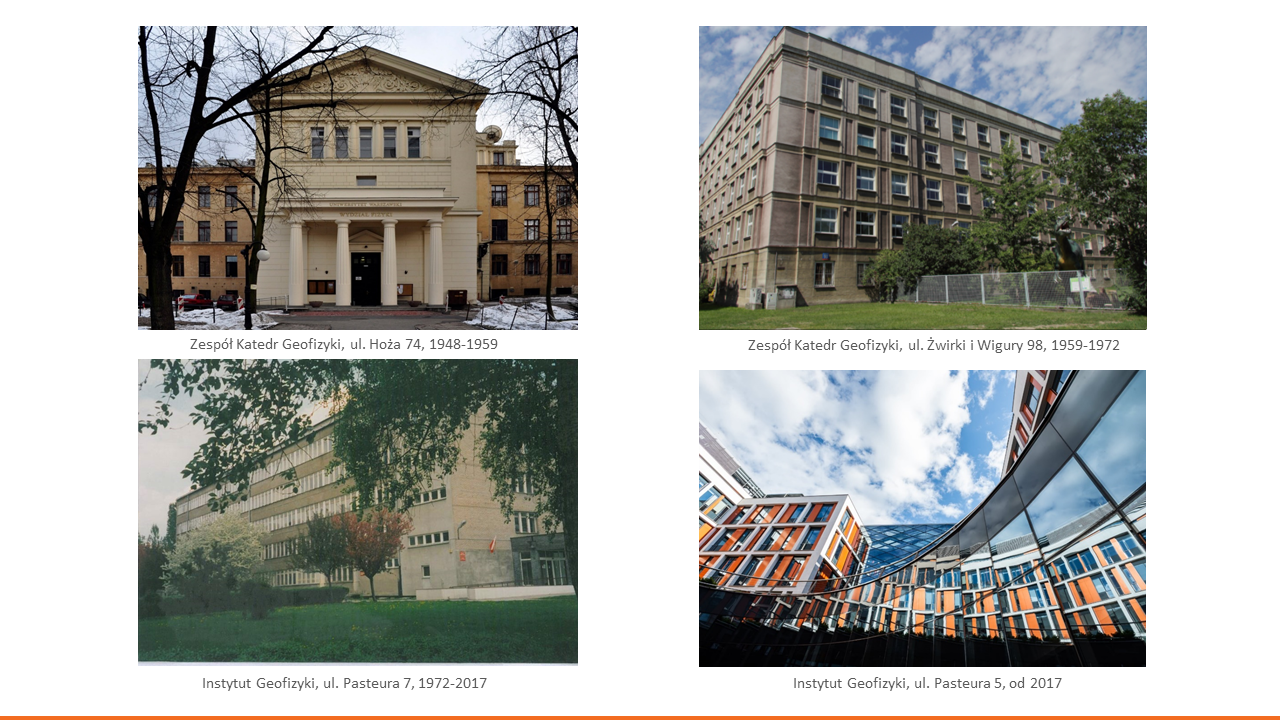
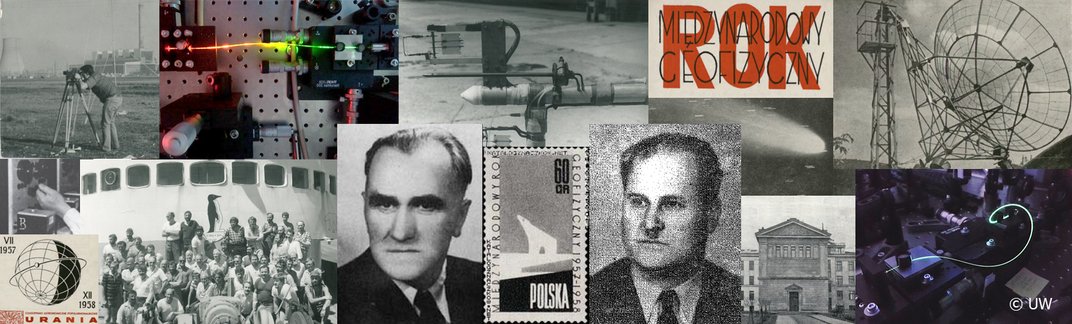
The roots of the Institute date back to the first post-war geophysics lectures held at the University of Warsaw in the 1946/47 academic year. Edward Stenz and Teodor Kopcewicz played a key role during this period, and in 1948-1949 they succeeded in establishing the Chairs of Geophysics I and II. The first home of both chairs was an annex at 74 Hoża Street, where the foundations of the Institute’s instrumental and library facilities were laid, while, at the same time, the station in Legionowo was rebuilt and regular atmospheric soundings were resumed. In 1952, both chairs were reorganized into the Chair of Litospheric Physics and the Chair of Atmospheric Physics, combining them into a unified Geophysics Chair Unit.
An important stage of development was the International Geophysical Year 1957-1958 and the establishment of the research station in Cha Pa (North Vietnam), which initiated a long-term Polish-Vietnamese collaboration. Participants in the Cha Pa expedition included the distinguished scientist Adam Dziewoński, later a laureate of the Crafoord Prize of 1998, and Krzysztof Haman, a researcher of cloud physics, designer of fast-response aircraft thermometers, and a pioneer of collaboration with the U.S. National Center for Atmospheric Research. An equally significant event was the renaming of the Geophysics Chair Unit to the Institute of Geophysics, which, in the following year, became part of the newly established Faculty of Physics at the University of Warsaw. In the subsequent decades, the Institute strengthened its position through research conducted both in the atmosphere and in the lithosphere. Within the Department of Atmospheric Physics, original instruments
were developed for installation on research vehicles, measurement towers, and aircraft, along with numerical modeling of clouds and transport processes in the atmosphere.
A significant breakthrough after 2000 was linked to the implementation of the CESSAR project in the years 2002–2006, which constituted one of the first scientific Centres of Excellence in Poland funded by European Union resources. Thanks to infrastructural investments, the Radiative Transfer Laboratory and the Remote Sensing Laboratory were established, and the team also developed the SolarAOT station and the national Poland-AOD aerosol network. In 2017, the Institute moved to a new building at 5 Pasteura Street, equipped with an observational platform, a meteorological station, and modern research laboratories.
The Institute’s history is also characterized by the consistent expansion of its research scope. In 1980, the Institute incorporated a Holography Laboratory at 7 Pasteura Street (in 1989 transformed into the Information Processing Laboratory and, since 2000, functioning as the Department of Information Optics), the third pillar of the Institute alongside atmospheric and lithospheric research. The intensive development of this field eventually led to the separation of photonics research, and on 1 February 2021 the Department of Photonics, led by Ryszard Buczyński, officially began its activities. From this long journey has emerged the contemporary Institute of Geophysics, University of Warsaw: a unit rooted in a strong geophysical tradition, yet developing through modern measurement techniques, modeling, optics, photonics, and research of pronounced international significance.
- Szymon Malinowski, Dąbrówka Stępniewska: From the Earth's core to stars: a brief history of the Institute of Geophysics FUW (text in Polish)
- Piotr Flatau: Krzysztof Haman Commemorative Volume - Life, science, and memories